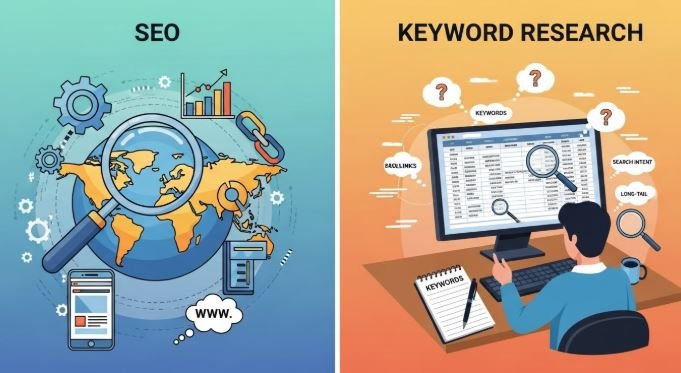
Understanding the difference between SEO and keyword research is essential for anyone aiming to improve their online presence. While both are intertwined, they serve distinct purposes. SEO (Search Engine Optimization) is the strategic process of improving a website’s visibility, rankings, and traffic, whereas keyword research is the process of discovering the exact words and phrases your audience is searching for. Many confuse the two because keyword research is a component of SEO, but SEO encompasses a much broader set of strategies. Essentially, keyword research is the intelligence, and SEO is the execution.
Short Answer — what is the difference between seo and keyword research
In short, SEO is the overarching strategy to rank websites, while keyword research identifies the specific terms that drive traffic and conversions. SEO starts when you begin optimizing your website for search engines, including technical setup, content creation, and authority building. Keyword research starts earlier, when you explore search intent, user behavior, and competitive keywords. People often confuse the two because both impact visibility, but one is a method, and the other is a discovery tool that informs that method.
Core Explanation — Understanding SEO and Keyword Research
What Is SEO?
SEO (Search Engine Optimization) is the systematic process of improving a website’s rankings on search engines like Google. Its primary goal is to increase organic traffic while enhancing user experience and authority.
Key pillars of SEO include:
- Technical SEO: Ensures your website is crawlable, fast, mobile-friendly, and secure.
- On-page SEO: Optimizes individual pages for keywords, content structure, and user intent.
- Off-page SEO: Builds authority through backlinks, brand mentions, and social signals.
- Content Optimization: Aligns content with search intent, readability, and engagement metrics.
SEO is an ongoing, system-level strategy that requires constant monitoring and adaptation to algorithm updates.
What Is Keyword Research?
Keyword research is the process of identifying and analyzing the words and phrases that people type into search engines. Its purpose is to uncover opportunities for content creation, traffic generation, and conversion optimization.
Types of keywords:
- Informational: “What is SEO?”
- Navigational: “WordPress login”
- Commercial: “Best SEO tools 2025”
- Transactional: “Buy SEO software online”
Keyword research is primarily a data discovery process. It informs your content strategy, PPC campaigns, and overall SEO roadmap.
How Keyword Research Fits Inside SEO
Keyword research is foundational to SEO. Without it, SEO strategies lack direction. The difference lies in execution versus intelligence:
- Execution (SEO): Optimizing, building authority, technical fixes.
- Intelligence (Keyword Research): Discovering what to target, understanding search intent, identifying opportunities.
SEO cannot succeed without the guidance of keyword insights.
What is the difference between seo and keyword research in practice
SEO vs Keyword Research — Strategic vs Tactical Roles
- SEO: Acts as the full roadmap for achieving online visibility and conversions.
- Keyword Research: Serves as the compass guiding the strategy.
- Focus: SEO is long-term, while keyword research provides tactical short-term insights that inform execution.
SEO vs Keyword Research — Goals, Scope, and Output
| Factor | SEO | Keyword Research |
|---|---|---|
| Purpose | Increase visibility and traffic | Discover target keywords |
| Scope | Full website strategy | Focused on data collection and insights |
| Timeline | Long-term | Short- to medium-term |
| Tools Used | Rank trackers, audit tools, analytics | Keyword planners, SERP analysis, trend tools |
| Output | Optimized pages, backlinks, traffic growth | Keyword lists, search intent mapping |
| Skillset Required | Technical, content, link-building | Analytical, research-focused |
| Frequency of Use | Continuous | Periodic or campaign-based |
| Business Impact | Sustainable traffic & conversions | Supports content & SEO strategy |
Businesses often misuse keyword research by stopping at discovery without implementing SEO, which limits growth potential.
H2: Step-by-Step — How SEO and Keyword Research Work Together
Step 1 — Define Business and Search Goals
- Identify whether the focus is on brand visibility, lead generation, or revenue growth.
- Map these goals to search intent to ensure alignment.
Step 2 — Perform Keyword Research
- Start with seed keywords relevant to your industry.
- Analyze search intent to determine what users want.
- Score keywords for difficulty, opportunity, and relevance.
Step 3 — Build SEO Strategy Using Keyword Data
- Cluster related keywords into content themes.
- Map keywords to specific pages and blog posts.
- Optimize internal linking to support page authority.
Step 4 — Execute SEO Optimization
- On-page: Optimize titles, headings, meta tags, and content.
- Technical: Improve page speed, schema markup, and mobile usability.
- Authority: Build backlinks and leverage social proof.
Step 5 — Measure, Refine, and Scale
- Track keyword rankings and traffic.
- Analyze which keywords drive conversions.
- Continuously iterate and expand the strategy.
Common Misconceptions About SEO and Keyword Research
“Keyword Research Is SEO”
Believing this limits growth because SEO involves technical optimization, content strategy, and authority building beyond just keywords.
“SEO Is Just Adding Keywords”
Modern SEO prioritizes UX, EEAT, and technical performance. Keywords alone cannot drive results.
“You Can Skip Keyword Research If You Know Your Industry”
Assumptions often miss actual user search behavior, which can lead to targeting the wrong keywords.
When You Need Keyword Research vs When You Need Full SEO
Scenarios Where Keyword Research Alone Is Enough
- Market validation for a new product
- Content ideation for blogs or social posts
- PPC campaign targeting
Scenarios Where Full SEO Is Required
- Long-term organic traffic growth
- Competitive industries where authority is key
- Local and national search rankings
Tools Used for SEO vs Keyword Research
Keyword Research Tools
- Google Keyword Planner
- SEMrush, Ahrefs, Ubersuggest
- Google Trends for search popularity
SEO Tools
- Site audit platforms (Screaming Frog, Sitebulb)
- Rank tracking tools
- Backlink analysis platforms (Ahrefs, Majestic)
FAQs — what is the difference between seo and keyword research
What is the difference between SEO and keyword research for beginners?
SEO is the strategy to optimize your site, while keyword research finds the exact phrases users search for. Keyword research informs SEO decisions.
Can you do SEO without keyword research?
Technically yes, but it limits results because your content won’t target high-value search terms.
Is keyword research part of on-page SEO?
Yes, it informs title tags, headings, meta descriptions, and content optimization.
Which comes first, SEO or keyword research?
Keyword research comes first to guide your SEO strategy effectively.
Do paid tools matter for keyword research and SEO?
Paid tools provide accurate data, competitive insights, and advanced reporting, but free tools can also be effective for beginners.
How often should keyword research be done for SEO?
Regularly — at least every 3–6 months, or before new content campaigns.
Is keyword research more important than SEO?
No. Keyword research supports SEO, but SEO implements a comprehensive strategy that drives results.
Can keyword research alone rank a website?
No. Keywords without technical SEO, quality content, and backlinks won’t generate sustainable rankings.
Final Verdict — SEO vs Keyword Research Explained Simply
Keyword research is the compass; SEO is the journey. Keyword research identifies opportunities, while SEO executes the roadmap to achieve traffic, visibility, and conversions. Without keyword research, SEO lacks direction. Without SEO, keyword research lacks impact. Together, they create a powerful strategy for online success. For proper information and SEO services visit Incline Solution now!



Leave a comment