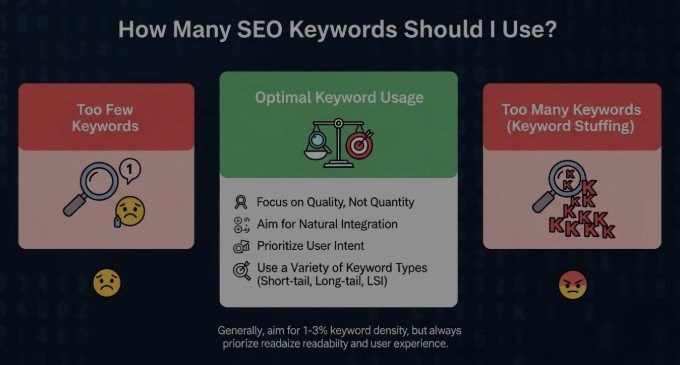
In the ever-evolving world of SEO, one question continues to puzzle content creators, marketers, and website owners alike: how many SEO keywords should I use? Striking the right balance between keyword optimization and natural content flow is crucial. Use too few, and your content might not rank. Use too many, and Google could penalize your page for keyword stuffing. In this guide, we’ll provide a step-by-step approach, backed by modern SEO practices, so you know exactly how to use keywords effectively on every type of page.
Short Answer — How Many SEO Keywords Should I Use?
The simplest answer: use one primary keyword per page and a handful of secondary or semantic keywords naturally integrated throughout your content.
- Primary keyword: The main focus of your page, usually appearing in the H1, URL, and key sections.
- Supporting keywords: Related terms, synonyms, and long-tail variations that provide context and improve topical relevance.
Using more keywords than necessary can harm your rankings, while strategic keyword placement enhances both SEO performance and user experience.
What Does “SEO Keywords” Actually Mean in Modern SEO?
The definition of SEO keywords has evolved. Gone are the days when stuffing a page with repeated keywords guaranteed rankings. Today, Google emphasizes topical relevance and user intent over sheer frequency.
Key Types of Keywords:
- Primary keyword: The single term you want to rank highest for.
- Secondary keywords: Related phrases that support your primary keyword.
- Semantic keywords: Terms Google associates with your topic through NLP (natural language processing).
- Related entities: Concepts Google understands via the Knowledge Graph, enhancing content authority.
Modern SEO is about covering a topic comprehensively rather than meeting a numeric keyword quota. Google’s algorithms evaluate context and content depth, not just keyword density.
How Many SEO Keywords Should I Use Per Page (Core Explanation)
While the “one primary keyword” rule is foundational, the number of supporting keywords varies based on content length, type, and search intent.
-
Primary keyword: 1 per page
-
Supporting keywords: 3–6 for short content, 10–20 for long-form content
-
Semantic keywords: Naturally integrated based on relevance
The key is natural integration. Content should flow for readers, with keywords strategically placed in H1s, H2s, H3s, and naturally throughout the body.
How Many SEO Keywords Should I Use for One Blog Post?
Blog posts often target informational search intent.
- Short posts (500–800 words): 1 primary keyword + 3–5 secondary keywords
- Long-form posts (1,200–2,500 words): 1 primary keyword + 6–10 secondary keywords + semantic keywords
Long-form content allows more secondary keywords without risking over-optimization. Quality and depth matter more than sheer keyword count.
How Many SEO Keywords Should I Use for a Landing Page?
Landing pages target conversion-oriented visitors, so clarity and focus outweigh keyword breadth.
- 1 primary keyword per page
- 1–3 supporting keywords
- Semantic keywords naturally tied to user benefits
Overusing keywords on landing pages can dilute messaging and reduce conversions, even if Google indexes the content.
How Search Intent Determines How Many SEO Keywords You Should Use
Search intent guides how many keywords you should incorporate. Matching keyword breadth to intent depth improves ranking potential.
- Informational intent: Multiple supporting keywords are helpful to provide comprehensive answers.
- Navigational intent: Focused keyword use, usually just the brand or page-specific term.
- Commercial investigation intent: One primary keyword + a few secondary keywords highlighting comparisons or features.
- Transactional intent: Minimal keyword variety; emphasis on conversion-focused terms.
Step-by-Step Guide — How to Choose the Right Number of SEO Keywords
Step 1: Identify One Primary Keyword
- Choose a keyword with relevant search volume and achievable ranking potential.
- Prioritize intent alignment: the keyword should match the purpose of the page.
Step 2: Find Secondary & Semantic Keywords
- Use People Also Ask, Google Autocomplete, and related searches.
- Leverage NLP tools to discover semantic clusters.
- Aim for keywords that naturally fit the content and support the primary keyword.
Step 3: Group Keywords by Intent, Not Volume
- Avoid targeting unrelated keywords that dilute authority.
- Organize keywords by informational, navigational, or transactional intent.
- Topical authority is built by covering a topic holistically, not redundantly.
Step 4: Map Keywords to Page Structure
- H1: Primary keyword
- H2s/H3s: Supporting and semantic keywords
- Intro & conclusion: Naturally include primary and secondary keywords
- Maintain natural frequency; avoid forcing keywords into sentences
Step 5: Validate With Top-Ranking Pages
- Analyze SERP winners for keyword placement patterns.
- Observe the balance between primary, secondary, and semantic keywords.
- Mirror their topical coverage without duplicating content.
How Many SEO Keywords Should I Use Based on Content Type
Content Type |
Primary Keywords |
Secondary keywords |
Semantic Keywords |
Risk Level |
|---|---|---|---|---|
| Blog Post | 1 | 3–6 | 10–20 | Low |
| Landing Page | 1 | 1–3 | 5–10 | Medium |
| Product Page | 1 | 2–4 | 8–12 | Medium |
| Pillar Page | 1 | 6–10 | 20–40 | Low |
| Homepage | 1 | 3–5 | 15–25 | High |
Common SEO Mistakes Related to Keyword Quantity
- Using too many keywords per page (keyword stuffing)
- Targeting multiple primary keywords per page
- Focusing solely on keyword density rather than relevance
- Ignoring semantic SEO signals
- Writing for search engines instead of human readers
How Google Evaluates Keyword Usage Today
Google’s algorithms have evolved to prioritize context, relevance, and user satisfaction:
- BERT & NLP: Understands content meaning, not just keywords
- RankBrain & Hummingbird: Evaluates related entities and context
- Content comprehensiveness signals: Pages covering the topic holistically rank higher
- Topical authority scoring: Consistency across supporting content improves SERP performance
FAQs — How Many SEO Keywords Should I Use?
How many SEO keywords should I use for one page?
Use 1 primary keyword and 3–6 supporting keywords for short content, and up to 10–20 for long-form content.
Can I rank for multiple keywords on one page?
Yes, if the keywords are closely related and support the same topic without diluting focus.
Is there a maximum number of SEO keywords per page?
No strict maximum, but overstuffing can harm readability and SEO performance.
Does keyword density still matter?
Not in the traditional sense. Google prioritizes natural use and topical relevance over repeated keyword density.
How many SEO keywords should I use for a 1,000-word article?
Typically 1 primary keyword, 5–8 secondary keywords, and 10–15 semantic keywords integrated naturally.
How many SEO keywords should I use for local SEO?
1 primary keyword + location-specific secondary keywords, naturally distributed across headers and content.
What happens if I use too many SEO keywords?
It can trigger keyword stuffing penalties, reduce readability, and confuse search engines.
Should I use the same keywords on multiple pages?
Avoid duplicating primary keywords across pages to prevent keyword cannibalization. Use variations and semantic terms instead.
Final Verdict — How Many SEO Keywords Should I Use to Rank #1?
- One primary keyword per page is essential.
- Secondary and semantic keywords should be used naturally to cover the topic comprehensively.
- Focus on content depth, intent alignment, and user experience, rather than sheer keyword quantity.
SEO Best-Practice Checklist:
- Identify one primary keyword per page
- Include 3–6 secondary keywords for short content or more for long-form
- Integrate semantic keywords naturally
- Align keyword strategy with search intent
- Validate against top-ranking pages for best practices
By strategically combining a primary keyword with relevant secondary and semantic keywords, your content can rank higher, satisfy user intent, and outperform competitors in the SERPs.



Leave a comment