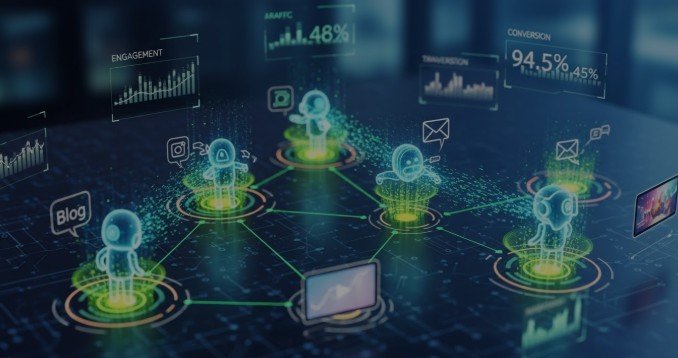
Content marketing is no longer driven solely by human planning, manual execution, and periodic optimization. Today, AI agents are fundamentally changing how content is researched, created, distributed, and improved. Understanding how AI agent transform content marketing is now essential for marketers, brands, and agencies that want to stay competitive in search, engagement, and scalability.
This guide delivers a complete, authoritative explanation covering strategy, execution, SEO impact, real-world use cases, and future trends so you walk away with a clear, practical understanding of this transformation.
Short Answer: How AI Agent Transform Content Marketing
AI agents transform content marketing by automating and optimizing the entire content lifecycle—from planning and keyword research to creation, distribution, personalization, and performance analysis. Unlike basic AI tools, AI agents can make autonomous decisions, adapt strategies in real time, and continuously improve results based on data.
In practical terms, this means faster content production, hyper-personalized messaging, better SEO performance, and lower operational costs—all while maintaining consistency at scale. The key takeaway: AI agents don’t just help marketers work faster; they fundamentally change how content strategies are built and executed.
What Does It Mean When AI Agents Transform Content Marketing?
AI agents are autonomous software systems designed to perform tasks, make decisions, and learn from outcomes with minimal human intervention. In a content marketing context, they operate across workflows that traditionally required multiple human roles.
The critical distinction lies between basic AI tools and AI agents. Traditional AI tools assist with isolated tasks—such as generating text or suggesting keywords. AI agents, however, connect tasks into intelligent systems that can plan, execute, evaluate, and refine content strategies on their own.
This is why AI agents represent a shift not merely an upgrade in content marketing. They move teams from manual execution to autonomous, always-on operations.
How AI Agent Transform Content Marketing at a Strategic Level
At the strategic level, AI agents enable:
- Autonomous content planning based on search trends and audience behavior
- Always-on optimization rather than scheduled updates
- Data-driven creativity, where ideas are shaped by real-time insights instead of assumptions
Core Explanation: The Role of AI Agents in Modern Content Marketing
AI agents operate across the entire content lifecycle. They integrate large language models (LLMs), automation platforms, analytics tools, and decision logic to function as self-improving systems.
Content marketing is uniquely suited for AI agent adoption because it relies heavily on repeatable processes, data feedback loops, and measurable outcomes like traffic, rankings, and conversions.
Key Capabilities That Allow AI Agents to Transform Content Marketing
AI agents excel at:
- Content ideation and topic discovery using search and competitor data
- Keyword and search intent analysis at scale
- Content creation, optimization, and continuous updating
- Distribution, repurposing, and automated performance tracking
How AI Agent Transform Content Marketing Across the Content Lifecycle
AI agents don’t improve just one stage they enhance every phase.
- Planning and research phase: Identifying gaps, trends, and opportunities
- Creation and optimization phase: Drafting, optimizing, and refining content in real time
- Publishing and distribution phase: Automating channel selection and timing
- Monitoring, updating, and scaling phase: Refreshing content based on performance signals
Examples of AI Agent Use Cases in Content Marketing
- SEO content engines that publish and update articles automatically
- Multi-channel content repurposing for blogs, email, and social media
- Personalized content experiences at scale
- Real-time content performance optimization based on user behavior
Step-by-Step Guide: Implementing AI Agents in Content Marketing
Step 1: Define Content Marketing Goals and KPIs
Establish clear objectives such as organic traffic growth, conversions, engagement metrics, or topical authority.
Step 2: Identify Where AI Agents Add the Most Value
Decide whether AI agents will support strategy, execution, optimization—or all three.
Step 3: Choose the Right AI Agent Framework
Select between single-purpose agents and multi-agent systems, as well as no-code platforms versus custom-built solutions.
Step 4: Train AI Agents on Brand Voice and Data
Provide style guidelines, audience personas, and historical performance data to maintain consistency.
Step 5: Deploy AI Agents Into Content Workflows
Integrate with your CMS, SEO tools, analytics platforms, and CRM systems.
Step 6: Monitor, Refine, and Scale
Maintain human oversight, establish feedback loops, and continuously optimize performance.
Comparison Table: How AI Agents Transform Content Marketing vs Traditional Methods
| Feature | Traditional Content Marketing | AI Agent-Driven Content Marketing |
|---|---|---|
| Content Production Speed | Slow, manual | Autonomous, scalable |
| Personalization | Limited | Hyper-personalized |
| Optimization | Periodic | Continuous, real-time |
| Cost Efficiency | High labor cost | Reduced operational cost |
| Performance Tracking | Manual analysis | Automated insights |
Benefits of How AI Agent Transform Content Marketing
The most significant benefits include increased efficiency, higher relevance, improved SEO performance, lower cost per asset, and faster experimentation cycles. AI agents enable marketers to do more with fewer resources without sacrificing quality.
Challenges and Limitations to Consider
Despite their advantages, AI agents require careful management. Risks include quality control issues, inconsistent brand voice, ethical concerns, and dependence on clean, accurate data.
How AI Agent Transform Content Marketing for SEO Specifically
From an SEO perspective, AI agents automate keyword mapping, align content with search intent, and keep pages fresh through dynamic updates. They also optimize internal linking structures and target SERP features like featured snippets.
Impact on Content Rankings and Organic Growth
The result is faster ranking improvements, dominance in long-tail keywords, and scalable topical authority across entire websites.
Industries Seeing the Biggest Impact From AI Agent Content Marketing
Industries benefiting most include SaaS companies, e-commerce brands, media publishers, marketing agencies, and large enterprise teams managing high content volumes.
Future Outlook: How AI Agent Transform Content Marketing Long-Term
Long term, we can expect fully autonomous content teams, predictive content strategies, AI-driven editorial calendars, and real-time personalization engines that adapt to individual users instantly.
FAQs About How AI Agent Transform Content Marketing
What is an AI agent in content marketing?
An AI agent is an autonomous system that plans, executes, and optimizes content tasks using data and learning models.
How do AI agents differ from AI writing tools?
AI writing tools assist with text creation, while AI agents manage entire workflows and make decisions.
Can AI agents fully replace human content marketers?
No. Human oversight remains critical for strategy, creativity, and brand integrity.
How AI agent transform content marketing for SEO performance?
They automate keyword research, content optimization, updates, and internal linking at scale.
Are AI agents safe to use for branded content?
Yes, when properly trained and monitored for quality and consistency.
What skills do marketers need when using AI agents?
Strategic thinking, data interpretation, and AI workflow management.
How much does it cost to implement AI agents in content marketing?
Costs vary from affordable no-code solutions to enterprise-level custom systems.
Will Google penalize AI agent-generated content?
No Google evaluates content quality, not how it is created.
Conclusion: Why How AI Agent Transform Content Marketing Is a Permanent Shift
The way how AI agent transform content marketing is not a temporary trend—it’s a structural change. By enabling autonomous execution, continuous optimization, and scalable personalization, AI agents give early adopters a decisive competitive advantage.
For marketers who want to remain visible, relevant, and efficient in an increasingly crowded digital landscape, embracing AI agent–driven content marketing is no longer optional it’s essential. For content related information and help writing it visit Incline Solution without any further delay.


Leave a comment