Why Understanding How Can Businesses Benefit from Using Analytics on Their Website Matters
In 2025, website analytics have become an essential tool for businesses of all sizes. While most companies collect data, many fail to extract actionable insights. This often leads to missed opportunities, poor user experience, and inefficient marketing spend. Understanding how can businesses benefit from using analytics on their website empowers decision-makers to improve performance, optimize conversions, and increase revenue.
By leveraging analytics, businesses can track user behavior, identify friction points, optimize content, and make strategic, data-driven decisions rather than relying on guesswork.
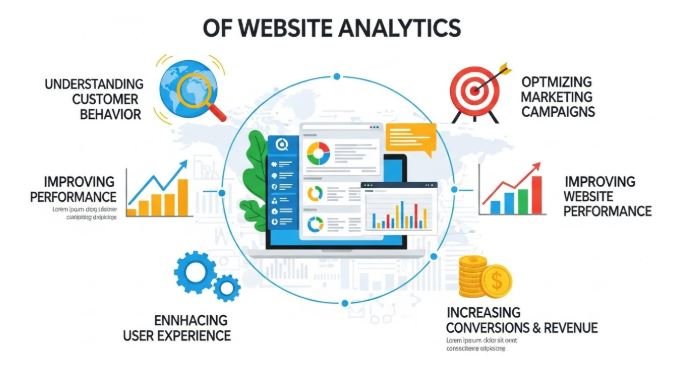
Businesses benefit from using analytics on their website by understanding user behavior, optimizing pages for conversions, improving marketing ROI, fixing performance issues, and making data-backed decisions.
What Website Analytics Actually Reveal
Key Metrics That Show How Can Businesses Benefit from Using Analytics on Their Website
Understanding which metrics to track is the first step in reaping the benefits of website analytics. Key metrics include:
-
Traffic Sources: Identify which channels—organic search, paid ads, social media, referrals—bring the most visitors.
-
User Flow and Drop-Off: Visualize where users exit your site to improve navigation.
-
Page Performance: Analyze load time, bounce rate, and time-on-page metrics.
-
Conversion Paths: Map how users move from landing to purchase or signup.
-
Behavior Metrics (CTR, Bounce Rate, Time on Page): Evaluate engagement and identify opportunities for improvement.
Why these matter: Tracking these metrics directly supports how can businesses benefit from using analytics on their website, enabling smarter decisions and better user experiences.
Quantitative vs. Qualitative Analytics
-
Quantitative Analytics: Numerical data from tools like GA4.
-
Traffic volume, conversions, pageviews.
-
-
Qualitative Analytics: Insights into user behavior.
-
Heatmaps, session recordings, scroll depth tracking.
-
Example: A heatmap might reveal users rarely scroll past the top 50% of a page, indicating content restructuring is needed.
Understanding User Behavior: The Foundation of Website Success
Identifying What Customers Actually Want
To truly benefit from analytics, you must differentiate between:
-
Search Intent: Why users landed on the page.
-
Interaction Intent: What actions they perform while on the site.
Example: Users scrolling to FAQs repeatedly on a product page signal a need for clearer product descriptions or enhanced onboarding guides.
How User Behavior Data Shows How Can Businesses Benefit from Using Analytics on Their Website
-
Reveals points of confusion.
-
Detects friction in navigation or checkout.
-
Shows opportunities for UX improvement, improving satisfaction and conversions.
Conversion Optimization Through Analytics
Tracking the Customer Journey
Tracking key conversion-related metrics helps businesses understand how can businesses benefit from using analytics on their website:
-
Funnel Analysis: Identify where users drop out of a sales funnel.
-
Checkout Abandonment Data: Pinpoint checkout steps causing friction.
-
Micro-Conversions: Track small actions like button clicks or form submissions to optimize flows.
Using Analytics to Increase Conversions
-
A/B Testing: Experiment with layouts, CTAs, and page designs.
-
CTA Placement Optimization: Position buttons where they are most effective.
-
High-Converting Content Identification: Focus on pages driving the highest conversions.
Mini Example: Moving a CTA above the fold increased conversions by 20% for a SaaS client.
Improving Marketing ROI Using Analytics
Which Channels Drive the Best Results?
-
Organic vs Paid: Measure cost-efficiency.
-
Referral Tracking: Identify partners driving high-quality traffic.
-
Social Media Attribution Models: Determine ROI from each campaign.
Budget Optimization Examples
-
Cutting underperforming campaigns.
-
Redirecting budget to high-value sources.
-
This is a direct way businesses understand how can businesses benefit from using analytics on their website, by ensuring resources generate measurable returns.
Technical and Performance Analytics That Impact Growth
Speed & Core Web Vitals
-
Slow pages increase bounce rates; a 3-second delay can cost 40% of users.
-
Example: Reducing load time from 5s → 2s improved conversions by 15%.
Mobile Analytics
-
Mobile sessions often differ from desktop; mobile-specific UX tweaks can boost engagement.
-
Analyzing behavior across devices ensures you’re not missing opportunities.
Product & Content Strategy Optimized Through Data
Analytics Reveal Top & Weak Performing Pages
-
Conduct content-gap analysis to see what drives traffic vs. engagement.
-
Improve underperforming product pages to increase conversions.
How Insights Shape Future Strategy
-
Focus on content users actually demand.
-
Eliminate low-engagement pages.
-
Data-driven strategies demonstrate how can businesses benefit from using analytics on their website.
Real-World Data Examples: How Analytics Change Decisions
Practical Scenario 1
-
A retailer identified slow checkout as the main conversion barrier. After redesigning the process, revenue increased by 25%.
Practical Scenario 2
-
A blog tracked mobile bounce rates. By optimizing mobile layout, engagement rose 60%, highlighting the power of analytics.
Comparison Table: Traditional Decisions vs Data-Driven Decisions
| Decision Type | Traditional Approach | Data-Driven Approach (Using Analytics) | Benefit |
|---|---|---|---|
| Content creation | Guesswork | Analytics-informed content | Higher engagement |
| Marketing budget | Even spending | Targeted investment | Better ROI |
| UX design | Personal preference | Heatmap & flow analysis | Higher conversions |
| Product updates | Random assumptions | User data-driven updates | Increased sales |
| Technical fixes | Reactive | Proactive CWV monitoring | Better performance |
Step-by-Step How to Use Analytics to Improve Website Performance
-
Install GA4, Search Console, and a behavior analytics tool.
-
Set up conversion tracking for forms, buttons, and clicks.
-
Create dashboards for key metrics.
-
Analyze high-bounce pages weekly.
-
Monitor top-performing channels.
-
Run A/B tests on high-impact pages.
-
Apply findings and re-measure results.
Expert Tips:
-
Never rely on a single metric.
-
Correlate UX behavior with traffic sources.
-
Test small, track big.
Common Mistakes Businesses Make When Using Analytics
-
Tracking vanity metrics rather than actionable insights.
-
Ignoring mobile-specific data.
-
Failing to align analytics with business goals.
-
Implementing changes without testing.
-
Confusing correlation with causation.
-
Overlooking heatmaps and session recordings.
-
Neglecting page speed and technical metrics.
FAQs
-
How can businesses benefit from using analytics on their website for customer insights?
-
By understanding behavior patterns and identifying what users care about most.
-
-
Which analytics tools best support how can businesses benefit from using analytics on their website?
-
GA4, Hotjar, Microsoft Clarity, and Search Console.
-
-
Do small businesses benefit compared to large brands?
-
Yes, smaller datasets allow faster insights and actionable decisions.
-
-
Can analytics help increase conversions?
-
Absolutely; funnel tracking and behavior analysis guide optimization.
-
-
How do analytics improve content strategy?
-
By revealing which topics drive traffic, engagement, and leads.
-
-
Do analytics help reduce marketing costs?
-
Yes, by eliminating low-performing channels and campaigns.
-
-
How can businesses benefit from using analytics on their website for UX improvements?
-
Analytics pinpoint navigation friction and usability issues for correction.
-
-
Can analytics prevent revenue loss?
-
Yes, detecting broken pages or slow load times reduces abandonment.
-
-
How does data guide long-term business strategy?
-
It reveals trends and growth opportunities.
-
-
Do businesses need advanced skills to understand web analytics?
-
Basic insights are accessible; advanced interpretation may require training.
-
-
How can businesses benefit from using analytics on their website during seasonal campaigns?
-
By forecasting demand and optimizing promotions.
-
-
Is analytics useful for eCommerce only?
-
No, service-based businesses also gain actionable insights.
-
Conclusion
Understanding how can businesses benefit from using analytics on their website is no longer optional; it is essential. From uncovering user behavior and optimizing conversions to improving ROI and refining content strategies, analytics empower businesses to make informed, data-driven decisions. Any company that embraces analytics gains a long-term competitive edge, transforming raw data into actionable growth and revenue opportunities.



Leave a comment