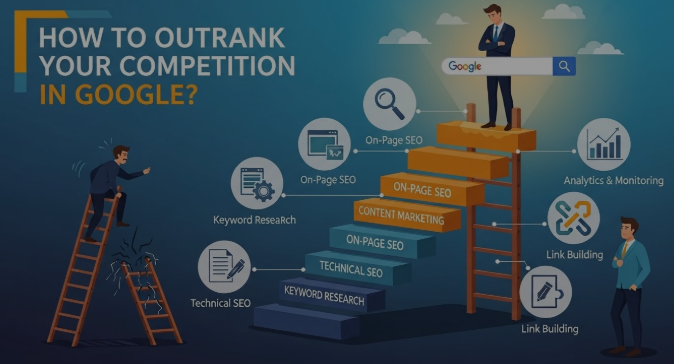
Outranking your competition in Google is not about hacks, tricks, or shortcuts. It’s about understanding how Google thinks, then executing better than everyone else consistently.
This guide breaks down exactly how to outrank your competition in Google, even if you’re competing against bigger brands, older websites, or companies with larger budgets.
Short Answer: How to Outrank Your Competition in Google
To outrank your competition in Google, you must target the right keywords, create content that is demonstrably better than what already ranks, optimize on-page and technical SEO, and build real authority signals. Rankings are won by relevance + trust + user satisfaction not by luck.
How Google Actually Ranks Websites (Reality, Not Myths)
Core Google Ranking Signals You Must Understand
Google ranks pages based on three core pillars:
- Relevance – Does your page fully answer the query?
- Authority – Does Google trust your site?
- User Experience – Do users engage, stay, and find value?
If you’re weak in any one of these, competitors will outrank you.
Why “Better Content” Alone Is Not Enough
Many websites publish “good content” and still don’t rank because:
- The content doesn’t match search intent
- On-page SEO is weak
- Authority signals are missing
SEO is a system not a single tactic.
The Role of E-E-A-T in Competitive Rankings
Google favors content that demonstrates:
- Experience
- Expertise
- Authoritativeness
- Trustworthiness
This is especially critical in competitive and YMYL niches.
How to Outrank Your Competition in Google (Strategic Breakdown)
Step 1: Analyze What’s Already Ranking
Before creating anything, analyze:
- Top 10 ranking pages
- Content depth and structure
- Keywords they rank for
- Backlinks and authority
You can’t beat what you don’t understand.
Step 2: Target the Right Keywords
Winning SEO focuses on:
- Intent-driven keywords
- Long-tail opportunities
- Keywords competitors rank for but don’t fully satisfy
High volume means nothing without conversion and intent.
Step 3: Build 10x Content
Your content must be:
- More comprehensive
- Better structured
- Easier to understand
- More actionable
Google doesn’t reward effort it rewards usefulness.
Step 4: Optimize On-Page SEO Perfectly
This includes:
- Optimized H1–H3 structure
- Keyword placement (natural, not forced)
- Internal linking
- Schema where relevant
Step 5: Build Real Authority
Authority comes from:
- High-quality backlinks
- Brand mentions
- Trusted sources referencing you
One strong link beats 100 weak ones.
Step 6: Win User Engagement
Google tracks:
- Click-through rates
- Dwell time
- Pogo-sticking behavior
Better UX = better rankings.
Keyword Strategy That Beats Competitors
Search Intent Mapping
Every keyword falls into:
- Informational
- Commercial
- Transactional
- Navigational
Match content type exactly.
Long-Tail vs Short-Tail Keywords
Long-tail keywords:
- Are easier to rank
- Convert better
- Build topical authority
Short-tail keywords come later.
Semantic SEO & Topic Clusters
Cover entire topics not just single keywords. This helps Google see you as an authority.
Content Optimization for Ranking Above Competitors
Depth, Structure & Formatting
Winning content uses:
- Clear headings
- Short paragraphs
- Tables, steps, and lists
Featured Snippets & PAA Boxes
Use:
- Short direct answers
- Bullet points
- Step-by-step sections
Updating Old Content
Refreshing content often produces faster ranking jumps than publishing new pages.
Technical SEO Foundations You Cannot Ignore
Site Speed & Core Web Vitals
Fast sites win.
Mobile-First Indexing
Your mobile version is your website.
Indexing & Architecture
If Google can’t crawl it, it can’t rank it.
Authority Building: The Difference Between #3 and #1
Backlinks That Matter
- Editorial links
- Niche-relevant sites
- Trusted publications
Brand Signals
Google rewards brands people search for.
Local SEO Authority
For local businesses, GBP optimization is non-negotiable.
How to Outrank Your Competition in Google
Step 1: Audit competitors and your site
Step 2: Fix technical and on-page issues
Step 3: Publish superior content
Step 4: Build authority and trust
Step 5: Track results and improve continuously
SEO is iterative not one-time.
Weak SEO vs Ranking-Winning SEO
| Factor | Weak SEO | Winning SEO |
|---|---|---|
| Keyword focus | Random | Intent-based |
| Content | Thin | Comprehensive |
| Backlinks | Low quality | Authoritative |
| UX | Ignored | Optimized |
| Updates | Rare | Continuous |
Common Mistakes That Block Rankings
- Chasing only high-volume keywords
- Ignoring intent
- Poor internal linking
- Skipping technical SEO
These mistakes keep sites stuck forever.
Frequently Asked Questions (FAQs)
How long does it take to outrank competitors in Google?
Typically 3–6 months with consistent execution.
Can a new website outrank established competitors?
Yes, with better targeting and superior content.
Is link quality or quantity more important?
Quality always.
Does user engagement affect rankings?
Indirectly, yes.
Can AI content outrank competitors?
Only if it’s genuinely helpful, accurate, and optimized.
Conclusion: The Sustainable Way to Outrank Your Competition in Google
Outranking competitors isn’t about gaming Google it’s about serving users better than anyone else while executing SEO with precision.


Leave a comment