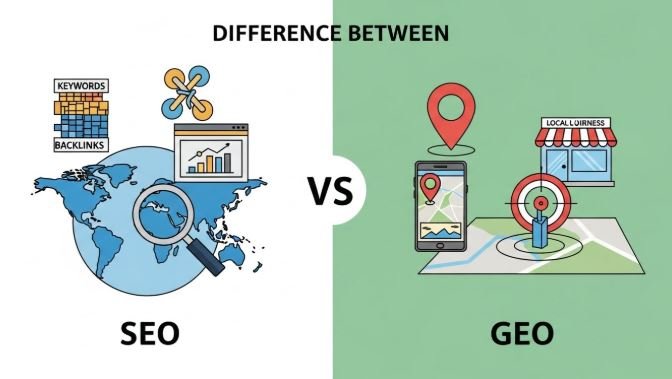
Short Answer – What Is the Difference Between SEO and GEO?
The difference between SEO and GEO is that SEO (Search Engine Optimization) focuses on ranking your website higher in search results to increase organic visibility, while GEO (Geo-Targeting) focuses on targeting audiences based on physical location – showing content, ads, or offers only to users in specific areas.
One-Line Comparison:
SEO helps you rank, while GEO helps you reach the right people based on geographic filters.
People often confuse these two because both are connected to visibility on Google, however, SEO affects who finds you, while GEO affects where those people are located when they find you.
Understanding SEO and GEO Individually
What Is SEO (Search Engine Optimization)?
SEO is the strategic process of optimizing websites, content, and site structure to rank higher organically on search engines like Google.
Goal of SEO: Increase organic search traffic, improve website authority, and secure top positions so users click without paid ads.
Types of SEO:
-
On-Page SEO: Keyword research, content optimization, meta tags, internal linking, UX.
-
Off-Page SEO: Backlinks, authority building, PR.
-
Technical SEO: Website speed, crawlability, structured data, mobile performance.
When implemented well, SEO improves visibility, trust, ROI, CTR, brand discoverability, and long-term lead generation.
What Is GEO (Geo-Targeting / Geographic Optimization)?
GEO is a location-based digital marketing method that customizes ads, content, or messaging based on user geography, country, city, ZIP code, radius, or even live location tracked via devices.
Purpose of GEO: Reduce wasted spend and increase conversion rates by making marketing location-specific.
Local vs. Hyperlocal:
- Local: Target entire city or region (e.g., “Web Design Services in Dallas”)
- Hyperlocal: Pinpoint streets or buildings (e.g., “Restaurant ads for users inside XYZ Mall”)
Brands use GEO to:
- Drive physical store visits
- Generate local leads
- Boost Google Maps visibility
- Personalize marketing by weather, culture, or language differences
What Is the Difference Between SEO and GEO (In-Depth Breakdown)
Difference Between SEO and GEO by Purpose
- SEO: Rank and attract search intent users globally/nationally.
- GEO: Narrow audience to specific locations for targeted conversions.
Difference by Marketing Outcome
- SEO delivers awareness + organic traffic.
- GEO delivers store visits + localized actions such as calls, map directions, or restaurant reservations.
Difference in Tools Used
- SEO Tools: Google Search Console, Ahrefs, Screaming Frog, SEMrush.
- GEO Tools: Google Ads geo controls, Maps API, geo-fencing tools, Local Pack optimization systems.
Difference in Implementation Approach
- SEO → Keyword-rich content, backlinks, site audits.
- GEO → Location-based segmentation, radius targeting, localized landing pages.
Difference in Measurement & KPIs (Analytics)
SEO measures:
- Keyword ranking
- Organic sessions
- Backlinks
- Engagement metrics
GEO measures:
- Traffic by region
- Geo CTR (click-through rate by location)
- In-store visits & map clicks
- Local call-to-action conversions
Why Understanding the Difference Matters for Businesses
Many businesses fail because they do SEO but ignore GEO.
When to focus on SEO:
- You sell digital services/software
- Your audience exists beyond one city
- You need authority and long-term growth
When GEO matters most:
- Restaurants, clinics, dentists, plumbers
- Offline stores needing walk-in visits
- Location-specific promotions
Combining both creates 10× results:
Example: A dentist using SEO to rank “dentist services” + GEO to target users within 3 km can dominate local competitors.
People Also Ask – Related Sub-Questions
Is GEO part of SEO?
No, GEO is a targeting mechanism, while SEO is a ranking strategy. GEO can enhance local SEO, but does not replace it.
Can SEO work without GEO?
Yes. National brands, blogs, and SaaS companies often rely only on SEO.
Is GEO only for Google Ads or Local SEO?
GEO works across Google Ads, Instagram Ads, Facebook, TikTok, Waze navigation ads, and programmatic geo-fencing.
Does GEO affect rankings or only targeting?
GEO normally affects targeting, ranking remains driven by SEO factors. However, location-optimized content (city landing pages) can affect rankings.
Which is better: SEO or GEO for small businesses?
Physical businesses benefit more from GEO + Local SEO combined.
How do local searches (“near me”) relate to GEO?
Google uses proximity signals, meaning results depend on user location. GEO tactics help brands appear in these results.
How to Use SEO and GEO Together
Step 1 – Identify Target Audience & Geographic Scope
Define cities, ZIP codes, neighborhoods, and exact demographic intent.
Step 2 – Perform Core SEO
- Conduct keyword research
- Optimize pages, metadata, schema
- Publish high-quality blogs and authority content
Step 3 – Layer GEO Targeting
- Create location landing pages (e.g., “Digital Marketing in Austin, TX”)
- Optimize Google Business Profile
- Build citations: Yelp, Yellow Pages, Chamber of Commerce listings
- Enable geo-filters on ad platforms
Step 4 – Add Behavioral & Geo-Focused Personalization
Examples:
- Weather-based ads (umbrella discounts on rainy days)
- Language-specific landing pages
- District-based offers
Step 5 – Track & Measure Performance
Use:
- GA4 location filters
- Google Business Profile insights
- Geo CTR reports
- Heatmap tracking tools
SEO vs. GEO Explained Clearly
SEO vs GEO (Side-By-Side Differences)
Factor |
SEO |
GEO |
|---|---|---|
| Primary Goal | Improve rankings | Target audience by location |
| Scope | Global / national | Local / regional / hyper-local |
| Tools | Search Console, Ahrefs, Screaming Frog | Google Ads Geo, Maps API, Geo-fencing |
| Best For | Ranking visibility | Foot traffic & in-area conversions |
Where Each Strategy Is Used
Scenario |
Recommended Strategy |
|---|---|
| Online-Only SaaS | SEO |
| Physical restaurant, dentist, store | GEO + Local SEO |
| Multi-country brands | SEO + Geo-targeting |
| One-city small business | GEO + Local SEO |
| National ecommerce brand | Primarily SEO |
KPI Metrics Comparison
KPI Type |
SEO Metrics |
GEO Metrics |
|---|---|---|
| Visibility | Organic ranking | Geo CTR |
| Traffic | Sessions, organic users | Traffic by region |
| Conversion | Leads/sales | In-store visits, calls, map clicks |
How to Decide — Should Your Business Focus on SEO or GEO First?
Ask yourself:
- Do customers visit a physical location?
- Do you sell nationally or city-specific?
- Do you want brand awareness or fast conversions?
Example Logic:
- Local bakery → GEO first, then SEO later
- SaaS → SEO first
- Multi-location gym → Both simultaneously
EO + GEO Case Study Scenarios
Example – Local Clinic – Using GEO to Beat Competitors
Targeted ads only to users within 3 km, increasing walk-ins by +120% after combining Google Maps optimization + geo-ads.
Example – SaaS Brand – Using SEO to Scale Nationally
Created 50 authority blogs + backlinks → nationwide rankings → users converted online. No GEO necessary.
Example – Multi-Location Franchise – Hybrid Strategy
Each location got its own city landing page + unique geo-ads — increasing conversions across markets.
Tools, Platforms & Resources
Tools for SEO
Google Search Console, GA4, Screaming Frog, SEMrush, Ahrefs, SurferSEO
Tools for GEO
Google Business Profile, Geo-Fencing suites, Google Ads location controls, Local Pack rank tracking tools.
Common Mistakes (And How to Avoid Them)
Mistake – Thinking GEO alone will rank websites
GEO improves targeting, not rankings. You still need SEO.
Mistake – Using SEO keywords without location modifiers
Always add city names when optimizing local business pages.
Mistake – Not tracking geo-performance analytics
Measure results per ZIP code.
Mistake – Duplicate location pages
Create unique localized content for each city.
FAQs – 8 Important Questions
What is GEO in marketing?
Is GEO the same as Local SEO?
Can SEO include geo-targeting?
How long does SEO vs GEO take to show results?
Does GEO improve Google rankings?
Best examples of GEO targeting in real life?
Do small businesses need both SEO and GEO?
What is the difference between SEO and GEO in simple terms?
Conclusion – Final Word on the Difference Between SEO and GEO
The core difference between SEO and GEO is ranking vs targeting. SEO earns long-term visibility and credibility. GEO allows businesses to laser-target audiences based on geography and convert locally. To win online today, Hire Incline Solution now!
If you’re planning your strategy, start by deciding who you want to reach (GEO) and how you want to be found (SEO).



Leave a comment